
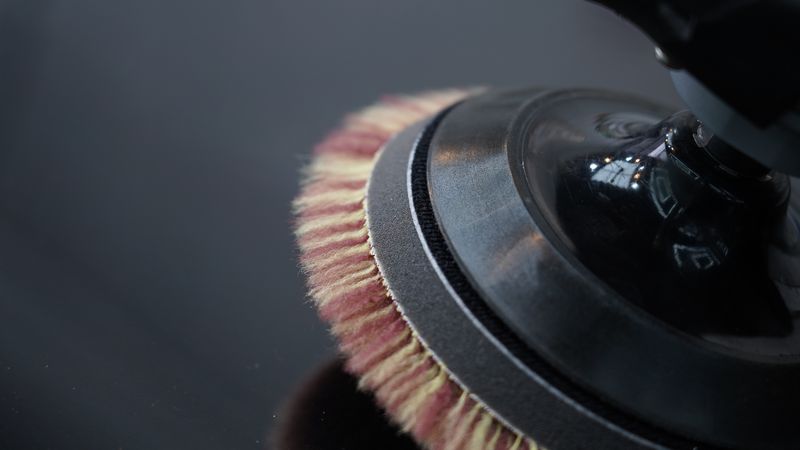
Short vs. Long Wool Pad — Which to Choose for Automotive Polishing Wax? Fiber Density Determines Cutting Power
In all my years doing automotive polishing, the question I get asked most is: “Should I buy a short wool pad or a long wool pad?”
Honestly, the logic behind that question is wrong. It”s not “which one is better” — it”s “which one suits your paint condition.” When DianYe helps customers pair up polishing solutions, we find 80% of people choose the wrong pad — not because the pad quality is bad, but because they never understood the fundamental difference between the two types.
Today, I”m breaking down short wool pads and long wool pads from the ground up — from microscopic structure to real-world operating temperature, from fiber density to paint matching — settling this once and for all.
1. The Real Difference: It”s Not Fiber Length, It”s Fiber Density
Many people think short wool pads cut aggressively because “short fibers are stiffer.” That”s way too superficial.
The real core factor is fiber density.
1.1 Why Can Wool Fibers Cut Paint?
Put a single wool fiber under a microscope, and you”ll see its surface is covered with scale-like cuticle structures (cuticle scales). These scales have sharp edges, and their composition is keratin — Mohs hardness around 2.5–3.0, roughly similar to the paint”s clear coat (Mohs 3–4).
What does this mean? Wool fibers don”t cut paint through “hardness domination” — they”re actually slightly softer than the clear coat. What actually works is the cumulative micro-cutting effect of thousands of scaled fibers contacting the paint simultaneously. Each fiber”s scale edge acts like a tiny scraper, “scraping” across the high points of the clear coat during rotation.
1.2 Quantified Fiber Density Data
| Pad Type | Fiber Density (filaments/sq inch) | Cutting Efficiency Rating |
|---|---|---|
| Low-end wool pad | <900 | Low, uneven cutting |
| Standard wool pad | 900–1200 | Medium |
| High-quality wool pad | 1200–1800+ | High, consistent cutting |
| Professional grade | >1800 | Highest, even pressure distribution |
The fundamental reason short wool pads cut strongest isn”t “short fibers are stiffer” — it”s that short fibers pack more tightly → higher fiber density per unit area → more “micro scrapers” working simultaneously → higher cutting efficiency.
Long wool pads have loosely arranged fibers. While each individual fiber is longer, the density is lower → fewer cutting points per unit area → less cutting power than a short wool pad.
That”s why two wool pads can differ by an entire grade in cutting power.
2. 11-Dimension Comparison: Short vs. Long Wool Pad
| Comparison Factor | Short Wool Pad | Long Wool Pad |
|---|---|---|
| Fiber length | ~10–15 mm | ~20–30 mm |
| Backing plate hardness | Rigid foam backing (white) | Flexible foam backing (black) |
| Cutting power | Strongest (level 5) | Strong (level 4) |
| Finish quality | Poorer (requires follow-up finishing) | Better (can handle both coarse and medium) |
| Heat dissipation | Poorer | Better |
| Debris clearance | Average (tight fiber structure) | Excellent (loose structure holds more debris) |
| Surface contact | Strong, suited for flat panels | Soft, suited for curved surfaces |
| Swirl mark risk | High | Moderate |
| Area suitability | Large and small areas | Medium and small areas preferred |
| Paint compatibility | Hard clear coats | Soft, fresh paint |
| Versatility | Coarse cutting only | Coarse + one-step method |
In short: short-fiber pads are the “heavy hitters” for aggressive coarse cutting on hard paint; long-fiber pads are the “all-rounders” for both hard and soft paint but with slightly less cutting power.
3. A Critical Difference Most People Overlook: Temperature
Choosing a pad isn”t just about cutting power — you also need to consider temperature control.
3.1 Infrared Thermometer Real-World Data
Someone tested with an infrared thermometer during continuous 2-minute work sessions:
| Pad Type | Measured Pad Temperature | Clear Coat Safety Status |
|---|---|---|
| Thin soft wool pad | 45°C | ✅ Safe |
| Long wool pad (low density) | 40–50°C | ✅ Relatively safe |
| Short wool pad (high density) | 55–60°C | ⚠️ Pause to cool down |
| Thick dense wool pad | 65°C | ⚠️ Approaching danger zone |
A 15–20°C difference. That 10–20 degree gap could be the dividing line between “safe operation” and “burning the paint.”
3.2 Clear Coat Temperature Safety Thresholds
| Temperature Range | Clear Coat Status | Operating Guidance |
|---|---|---|
| <50°C | Safe zone | Normal operation |
| 50–60°C | Warning zone | Reduce speed and pressure, prepare to pause |
| 60–80°C | Danger zone | Stop immediately — water-based clear coat begins softening |
| >80°C | Critical zone | Clear coat significantly softened |
| >180°C | Burn zone | Permanent clear coat deformation |
DianYe”s recommendation: when using a short wool pad with DianYe J2 Water-Based Polishing Wax for coarse cutting, pause every 2 minutes to check the pad temperature. If the back of your hand feels warm at 5 cm from the pad (~40–50°C) = safe. If it”s too hot to touch (~60°C) = time to rest.
A practical trick: during operation, lightly mist water onto the pad with a spray bottle — evaporation carries away friction heat, dropping pad temperature by 10–15°C. Note: “mist,” not “soak” — too much water will wash away the abrasive.
4. Which Pad for Which Paint Condition? Decision Guide
4.1 When to Choose Short Wool Pad
- German cars with hard clear coats (VW, BMW, Mercedes — high clear coat hardness)
- Accident repair repaints with deep oxidation layers
- Large areas with severe gloss loss needing aggressive cutting
- Using an RO rotary machine
Pairing: Short wool pad + DianYe J2 Water-Based Polishing Wax (coarse cutting wax) → coarse cut to level → foam pad + DianYe J5 Mirror Finish Restorer → fine polish to restore
4.2 When to Choose Long Wool Pad
- Japanese cars with soft clear coats (Toyota, Honda, Nissan — thin clear coat, 25–35 microns)
- Fresh paint within 4 hours of leaving the booth
- One-step method (coarse + medium in a single pass)
- Panels with many curves
Pairing: Long wool pad + J2 Coarse Cutting Wax (coarse cut) or Long wool pad + DianYe J3 3-in-1 Polishing Wax (one-step) → follow with foam pad + J5 Mirror Finish Restorer for gloss
4.3 DA Machine Users: Consider Microfiber Pads
One more thing. Many car owners use DA orbital polishers, not RO rotaries. Traditional long wool pads don”t work on DA machines — the DA”s eccentric vibration will tear apart loose fibers.
If your machine is a DA, there”s a better option for the coarse cutting stage: microfiber pads.
Microfiber pads use ultra-fine polyester + polyamide fibers, with fiber diameters of ~0.5–10μm — 5–10× thinner than wool fibers. Cutting power falls between wool pads and foam pads, but swirl marks are far fewer. European professional brand CarTec positions microfiber pads as “high-gloss cutting” — cutting power with minimal swirl risk.
DA machine + microfiber pad + J2 Water-Based Polishing Wax = “safe coarse cutting combo” — especially suitable for DIY car owners and novice technicians unfamiliar with RO machine operation.
5. Wool Pad Positioning in the Polishing Process
Regardless of short or long fiber, the wool pad”s position in the automotive polishing wax workflow is fixed: coarse cutting only.
The complete polishing process is three steps:
- J2 coarse cut leveling: Wool pad (short or long fiber) + J2 Water-Based Polishing Wax 1000g — removes oxidation layer and deep scratches, levels the paint surface
- J3 medium cut brightening: Medium-cut foam pad + J3 3-in-1 Polishing Wax 1000g — eliminates swirl marks from coarse cutting, boosts gloss
- J5 fine polish restoration: Ultra-soft foam pad + J5 Mirror Finish Restorer 1000g — removes all micro-marks, restores mirror finish
Finally, apply a layer of X1 Quick Liquid Wax 500ml for protection, and the full process is complete.
Wool pad coarse cutting always leaves swirl marks — you must follow up with a foam pad for finishing. This is an iron rule, no exceptions. Skip this step? You”ll deliver a car covered in spiral swirl marks to the customer. Total waste of effort.
6. Service Life and Maintenance
| Type | Normal Service Life | Replacement Signals |
|---|---|---|
| Short wool pad | 20–30 cars | Visible fiber shedding, brittleness |
| Long wool pad | 15–25 cars | Fiber tangling, loss of elasticity |
| High-quality treated pad | 50–80 cars | Requires careful daily maintenance |
Here”s a concept worth knowing — the fiber memory effect. Natural wool has an underrated property: even after repeated compression, quality wool fibers can recover their original loft. A good pad still has fibers standing upright after dozens of uses → the cutting surface always maintains effective contact with the paint. A poor pad”s fibers collapse after just a few uses → effective cutting points drop dramatically.
Recommended maintenance: after each use, immediately clean with a steel brush to remove residual wax and paint debris. Periodically hand-wash with warm water and neutral detergent, air dry in shade — never sun-dry.
7. Operating Precautions Summary
- Speed control: Wool pad overall speed 1000–2000 rpm; edge areas reduce to 800–1000 rpm
- Temperature monitoring: Keep pad temperature below 50°C; stop immediately if the pad feels hot to the touch
- Pressure control: “Move fast, press light” — pad weight + light pressure, no more than 2–3 seconds per spot
- Caution with Japanese cars: Thin clear coat (25–35μm) — foam pads recommended throughout; if wool pad is necessary, reduce speed by 200–300 rpm
- Traditional long wool pads are incompatible with DA machines: DA machines require DA-specific wool pads or switch to microfiber pads
- Wet polishing strategy: In concave areas where heat dissipation is difficult, keep the pad surface wet to reduce temperature
8. Summary: One Table to Help You Decide
| Your Situation | Recommended Pad | Paired Automotive Polishing Wax |
|---|---|---|
| German cars / hard paint / heavy oxidation | Short wool pad | J2 cutting wax → J5 restorer |
| Japanese cars / soft paint / new car | Long wool pad | J2 cutting wax or J3 one-step → J5 restorer |
| DA machine users / DIY owners | Microfiber pad | J2 water-based wax → J5 restorer |
| Many curves / complex shapes | Long wool pad | J3 3-in-1 polish → J5 restorer |
Choosing the right pad is just step one. The pad-and-wax pairing, machine-and-speed matching, temperature and pressure control — these details combined determine the final paint finish.
Search DianYe for more automotive polishing guides.